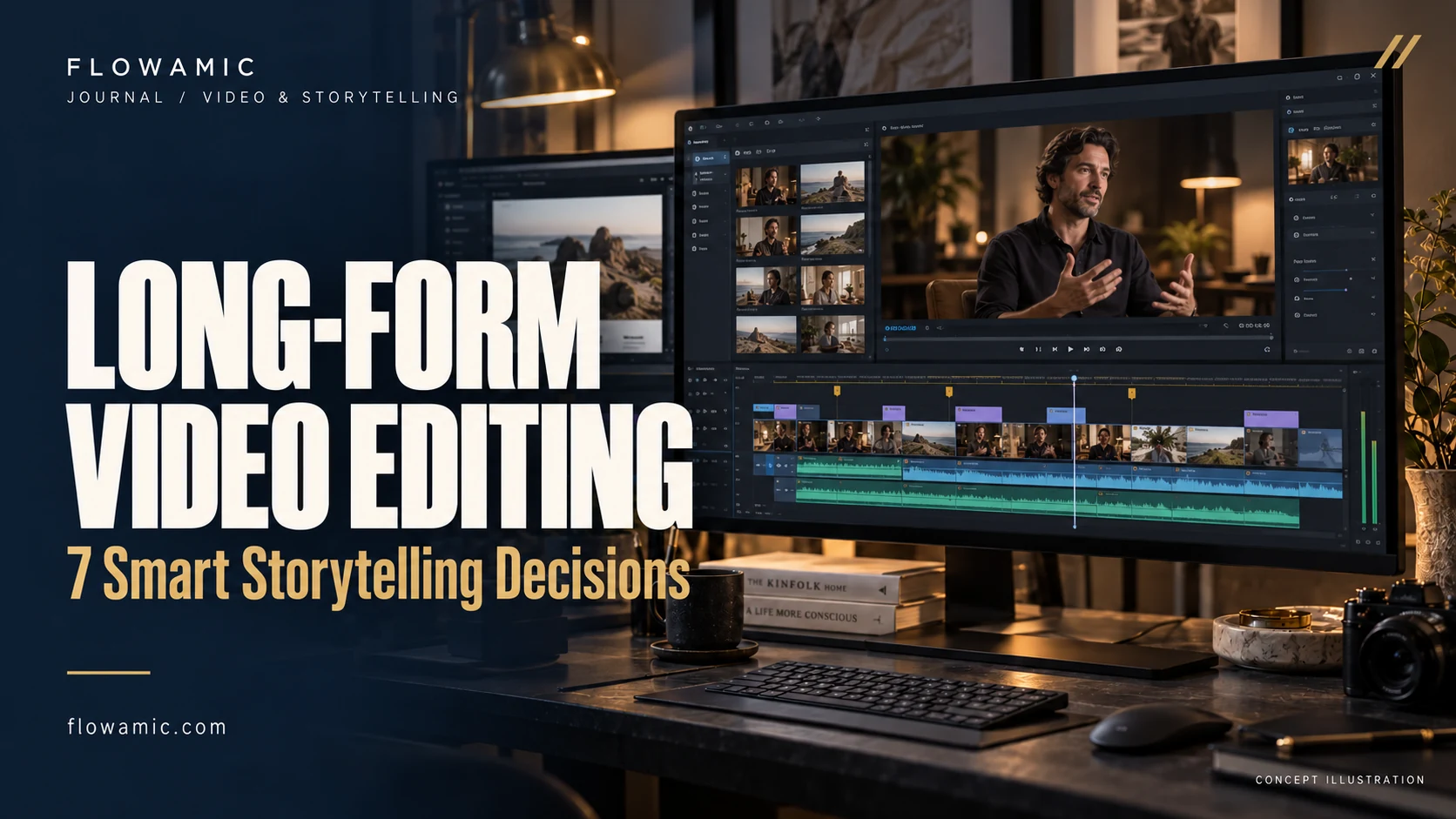
Long-form video editing is about helping a viewer follow an idea across a sustained piece. Pace matters, but a fast cut is not automatically a useful cut. Flowamic’s Long-form Edit 01 portfolio clip gives a concrete starting point for discussing structure, continuity and review. The embedded asset is the existing portfolio excerpt, not a complete client episode or a performance report.
THE PRACTICAL TAKEAWAY
Good long-form editing gives the idea room to land.
1. Decide what the viewer should understand
Begin with the purpose of the piece and the audience’s existing knowledge. Identify the main question the edit needs to answer.
A clear purpose helps decide which material supports the story and which material belongs elsewhere. Ask the producer for must-keep points and sensitive exclusions before assembly. Editorial decisions become easier when the team agrees on the message rather than just a target duration.
2. Build a coherent assembly
Review the footage, log useful sections and assemble the argument or story in a sensible order. Look for gaps before adding decorative elements.
A section may need context, a transition or an alternative take to make sense. Do not conceal a missing explanation with faster pacing. The first assembly is a chance to check whether the material can support the intended piece.
3. Use pacing with a purpose
Vary rhythm according to the content. A complicated explanation may need room, while a repetitive passage may benefit from tightening.
Preserve enough context for a viewer encountering the subject for the first time. Use cutaways when they add information or improve continuity. A consistent visual language helps the piece feel intentional without making every moment look identical.
4. Related work: Long-form Edit 01
Play the actual portfolio clip below to inspect the existing sample. It is listed in the portfolio’s long-form category and runs approximately 55 seconds.
That makes it an excerpt for reviewing editing style, not evidence of the length of a full deliverable. No retention uplift, audience growth or client approval is claimed. A project brief should specify the intended episode length separately.
5. Treat sound as part of comprehension
Check speech clarity, transitions between takes and the relationship between dialogue and music. Request source audio and licensing information during discovery.
Background sound should support the piece without competing with its message. Review the output on more than one playback device when practical. Record any source limitations rather than implying that every audio problem can be removed completely.
6. Give feedback a usable format
Ask reviewers to provide time-coded comments and distinguish factual corrections from stylistic preferences. Consolidate feedback through one owner where possible.
Agree the number of revision rounds and the point at which structural changes become additional scope. This protects the schedule and lets the editor resolve the real concern instead of interpreting contradictory comments from several people.
7. Deliver for the actual destination
Confirm aspect ratio, resolution, caption requirements, thumbnail responsibilities and export format in the brief. Review the final export rather than only the timeline preview.
Check the opening, ending, audio and any text that could be hidden by platform controls. Long-form video editing is complete when the agreed deliverables are usable, clearly named and ready for the intended publishing workflow.
Common questions
Is the embedded video a complete long-form episode?
No. It is the existing approximately 55-second portfolio excerpt labelled Long-form Edit 01.
What should an editing brief contain?
Include source footage, the intended audience, final duration, reference style, publishing destination, licensing information and a single feedback owner.
FROM READING TO A REAL BRIEF
Your long-form video editing project brief
Tell us what you need to publish or build, who it is for and which parts already exist. For an agency partnership, include the client context you can share, the required deliverables and the approval process.
- Define the primary audience and one useful outcome.
- List available assets, content and any access requirements.
- Set a target deadline, budget range and feedback owner.
- Agree scope, acceptance checks and handover before production.
We can discuss a focused paid pilot before a wider engagement. Scope, timing and pricing are agreed after reviewing the brief.
Discuss your project ↗Explore this service ↗CONTINUE ON LINKEDIN
A practical conversation, beyond the page
Follow Flowamic on LinkedIn for service notes, portfolio updates and conversations about agency delivery.
Visit Flowamic on LinkedIn ↗