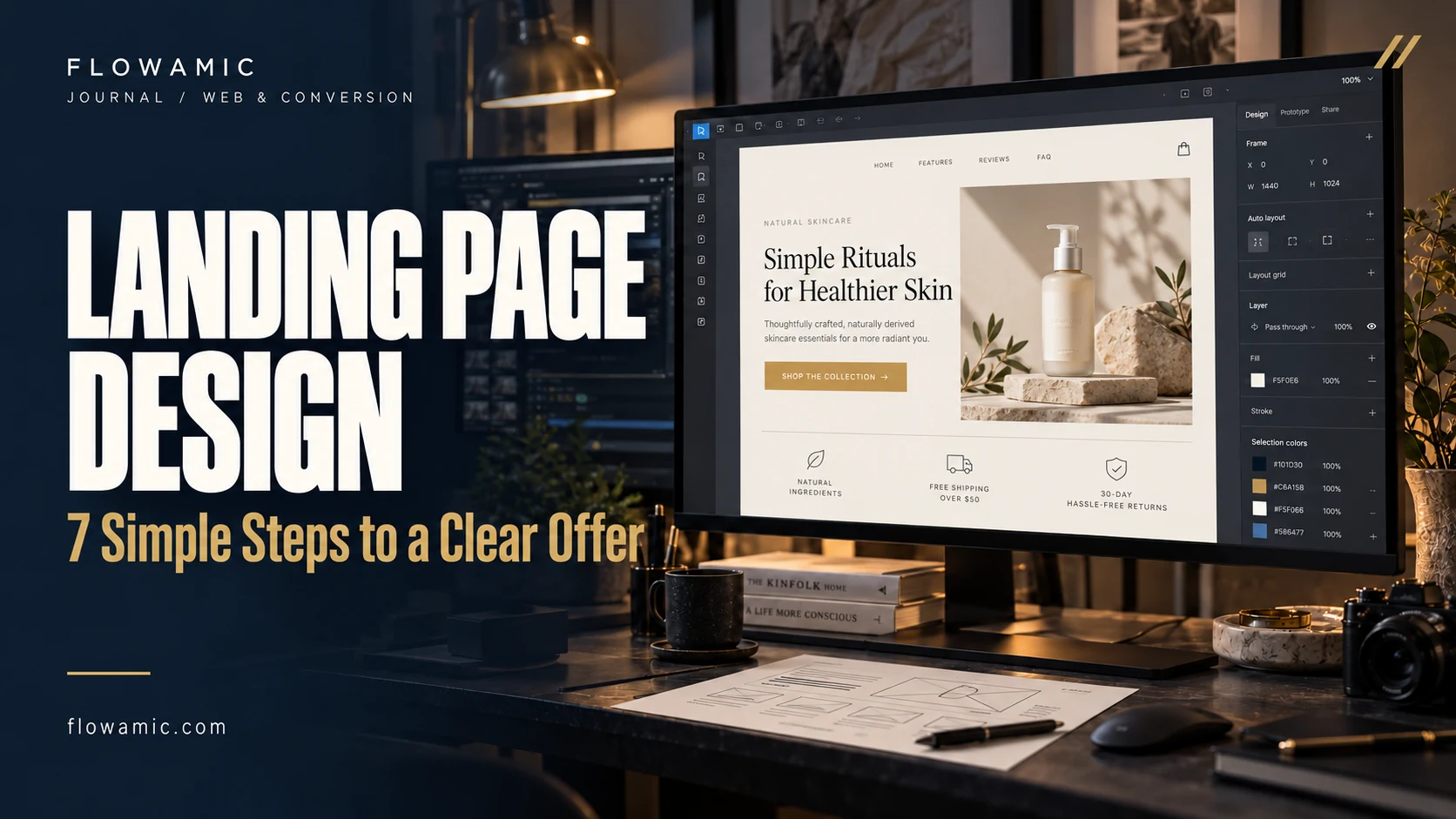
Landing page design should help one defined audience understand one offer and choose a useful next step. It is tempting to add every message a business wants to communicate, but that often weakens the page. Flowamic’s Amber Gray independent redesign concept explores a personal-brand introduction, learning themes, a story and frequently asked questions within a single presentation.
THE PRACTICAL TAKEAWAY
A landing page gets stronger when its next step gets clearer.
1. Choose one primary action
Decide whether the page is asking someone to enquire, register or explore a product. Secondary information can support that action, but competing buttons should not all receive equal emphasis.
Write the action in language that describes what happens next. If the destination is a conversation, avoid a button label that suggests an instant purchase or a completed booking.
2. Match the opening to the audience
Use the first heading and short introduction to explain who the offer is for and what it contains. A visitor arriving from a LinkedIn post should recognise the same topic on the page.
Avoid adding a broad claim that the body cannot support. The opening should reduce uncertainty and invite a relevant reader to continue, rather than promise a result that has not been measured.
3. Build a reading sequence
Arrange the page around the questions a visitor asks: what is this, is it relevant, what is included and what do I do next? Give each section a clear heading.
Use short paragraphs, purposeful lists and enough spacing for comfortable reading. A strong page can still have depth; it simply gives the reader a useful route through the information.
4. Related work: the Amber Gray concept
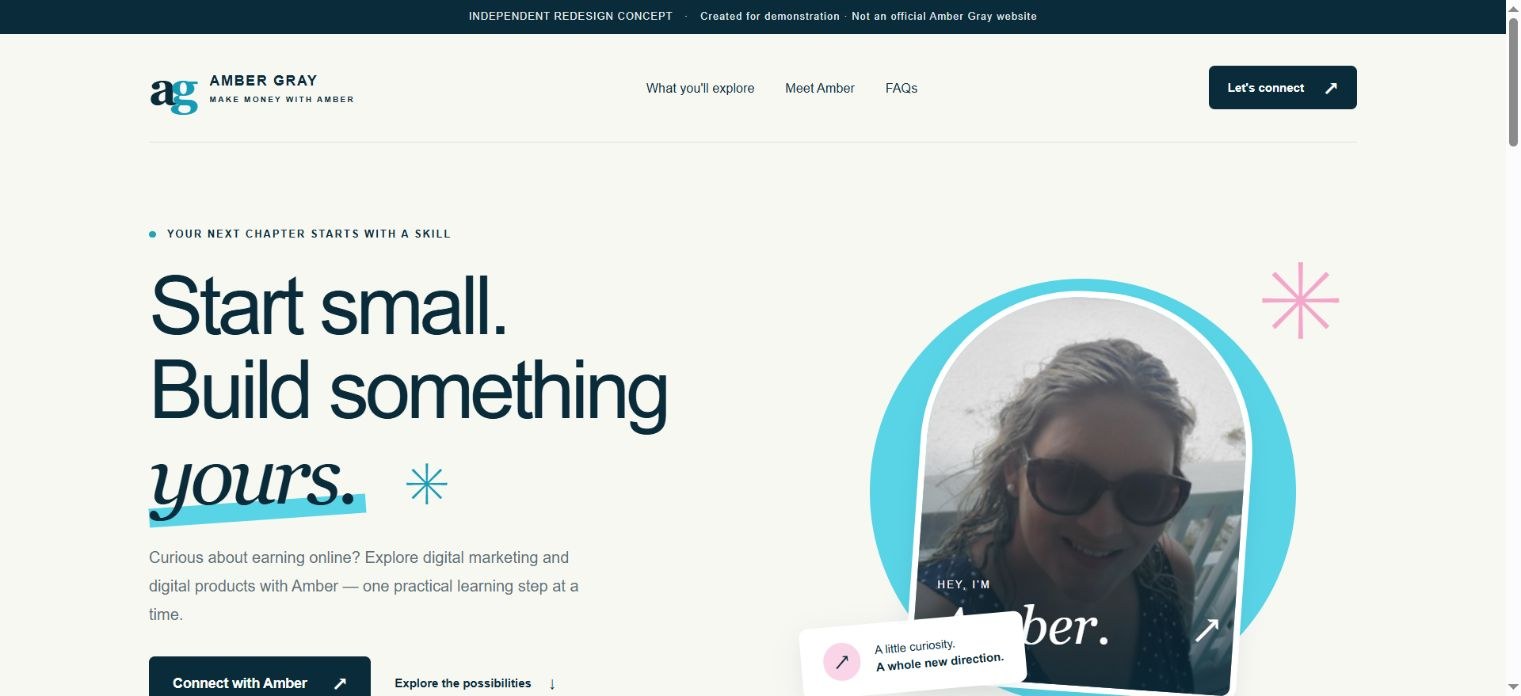
The Amber Gray page is an independent demonstration concept, not an official Amber Gray website. Its documented scope includes an introduction, learning themes, a personal story and FAQs.
The actual concept screenshot supports discussion of layout and content hierarchy. It should not be interpreted as a client endorsement, campaign performance report or proof of a commercial relationship.
5. Use visuals to explain the offer
A relevant product screenshot or work example can answer questions that generic imagery cannot. Caption the visual so the reader knows what they are seeing.
Keep important text as readable HTML rather than embedding the entire offer in an image. For a long website preview, allow the reader to inspect the complete capture instead of cropping away the information being discussed.
6. Keep measurement specific
Choose events that reflect the intended action, such as a visit to the enquiry page or a submitted form where the system supports it. Tag the incoming LinkedIn link consistently.
A page-view count alone cannot establish enquiry quality. Review the actual visitor journey and follow the applicable consent requirements before adding analytics or tracking tools.
7. Test the message and the mechanics
Check the destination of every call to action, form validation, mobile spacing and link previews. Confirm that the title, description and social image describe the page accurately.
Landing page design should be reviewed against the agreed brief before campaign traffic arrives. A short test with someone outside the build team often exposes unclear labels and missing explanations.
Common questions
Is the Amber Gray page a client website?
No. It is explicitly an independent redesign concept used to demonstrate layout and content hierarchy.
How much copy does a landing page need?
Enough to answer the audience’s buying questions. Scope, risk and offer complexity matter more than a fixed word count.
FROM READING TO A REAL BRIEF
Your landing page design project brief
Tell us what you need to publish or build, who it is for and which parts already exist. For an agency partnership, include the client context you can share, the required deliverables and the approval process.
- Define the primary audience and one useful outcome.
- List available assets, content and any access requirements.
- Set a target deadline, budget range and feedback owner.
- Agree scope, acceptance checks and handover before production.
We can discuss a focused paid pilot before a wider engagement. Scope, timing and pricing are agreed after reviewing the brief.
Discuss your project ↗Explore this service ↗CONTINUE ON LINKEDIN
A practical conversation, beyond the page
Follow Flowamic on LinkedIn for service notes, portfolio updates and conversations about agency delivery.
Visit Flowamic on LinkedIn ↗